Side-bet file
Super 4 Blackjack Side Bet — Progressive Rules, Payouts and the Math
A progressive wager that turns the first four cards on the table into a poker hand, then adds a catch most players miss: on the standard version, nothing pays unless the dealer has blackjack. Here is what the published analysis actually says.
Published Sunday, July 12, 2026 · 9 min read
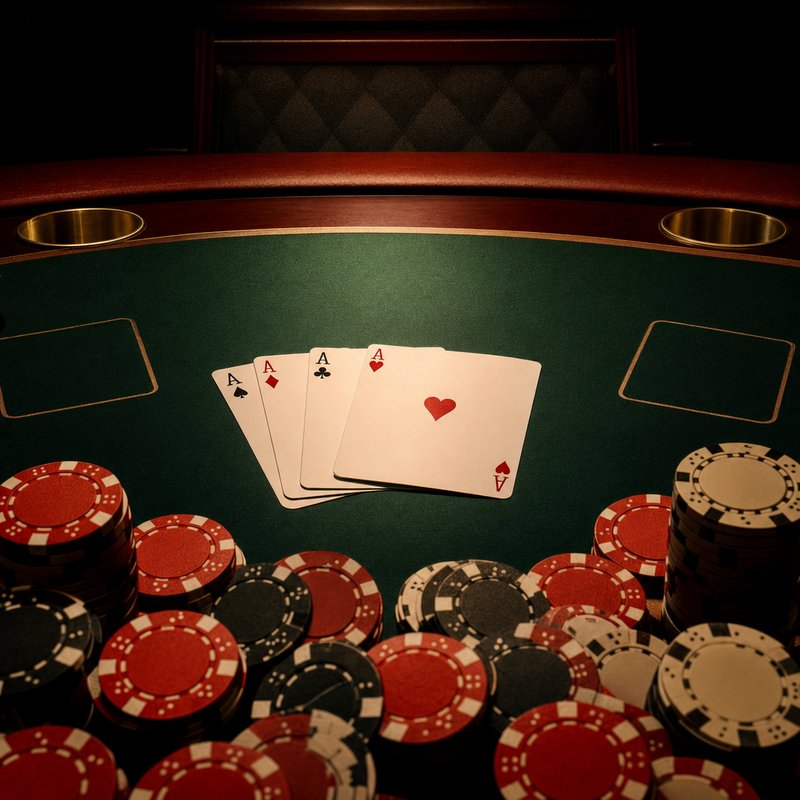
Super 4 payouts: the progressive pay table
| Outcome | Pays | Notes |
|---|---|---|
| Royal flush in diamonds | 100% of jackpot | the full progressive meter |
| Royal flush, other suits | 10% of jackpot | |
| Three of a kind | $750 | |
| Straight | $500 | |
| Flush | $400 | |
| Two pair | $300 | |
| All same color | $100 | |
| Pair | $75 | |
| Dealer blackjack, no qualifying hand | $25 |
Most side bets have one long shot. Super 4 blackjack has two, stacked, and the second one is hiding in the fine print: the four-card poker hand on the felt pays nothing at all, on the standard version, unless the dealer turns over a blackjack first. That single sentence, confirmed in the Wizard of Odds analysis, is the entire story of this wager, and casinos are under no obligation to shout it.
The pitch reads well on the rack card. Your two cards and the dealer’s two cards become a four-card poker hand; pairs, flushes, straights and trips collect fixed prizes; a royal flush takes a slice of a progressive jackpot, and a royal in diamonds takes all of it. A live meter climbing over a blackjack table sells itself.
Then the gate closes. The dealer holds blackjack about once in twenty-one hands, so roughly 95% of the time, your super 4 blackjack wager is dead before anyone looks at what poker hand you were holding.
How the super 4 blackjack side bet works
The bet is a flat $5 on the marked progressive spot before the deal, the fixed sizing typical of metered wagers, since every stake feeds the same jackpot pool. There are no decisions afterward. When the hand ends, resolution follows the version the casino installed.
On version one, per Wizard of Odds: no dealer blackjack, no pay, full stop. With a dealer blackjack, the four initial cards, yours and the dealer’s together, are graded as a poker hand, and you collect the best rung you reach, from a $25 floor for the blackjack alone up through pairs, color, two pair, flush, straight and trips, into the royal-flush jackpot tiers.
Two later versions loosen the gate by a hair, paying $10 when the dealer shows an ace but misses blackjack. That consolation exists because players kept watching aces flip over ten-less and eating total losses; it changes the experience more than the math.
Note the payout convention. Everything is “for one,” meaning the $5 wager itself is never returned: the $75 pair rung nets you $70. Between the flat sizing, the for-one pays and the blackjack gate, this bet’s structure resembles a drawing ticket far more than a table wager.
The dealer-blackjack gate is the whole math
Every analysis of this bet begins and ends with the gate, so run the two layers in order.
Layer one: the dealer needs ace-plus-ten as their first two cards, which happens a little under 5% of the time in a multi-deck shoe. This is precisely the event the insurance bet prices, and it is uncommon enough that insurance itself is famously a losing wager.
Layer two: given the blackjack, your side of the felt must now cooperate. The dealer’s ace and ten are locked into the four-card hand, so your two cards are drawing at combinations through them. A pair anywhere in the four cards clears the $75 rung easily enough, but flushes need both your cards matching the suit of one of the dealer’s, straights need connectors around a locked ace-ten, and the royal tiers need your two cards to complete a suited high run through the dealer’s exact holdings while the blackjack condition also stands.
Multiply the layers and the fixed rungs’ rarity explains the published return: 52.89% to 64.84% of money bet comes back through every non-jackpot prize combined, by version and deck count. For scale, even the pit’s notorious donations return around 75 to 80 cents, and the sanely priced spots on the full side-bet board return 94 to 97.
Half your money, in expectation, rides on rungs you will rarely touch. The rest is a bet on a number on a sign.
The meter, and what it would take to go fair
Progressive math has one honest question: how high must the jackpot climb before the bet stops being terrible? Wizard of Odds supplies the conversion rate, with the meter adding between 0.33% and 1.01% of return per $10,000, depending on version and decks.
Take the friendliest published case, a 64.84% fixed return with the meter contributing 1.01% per $10,000. Closing a 35-point gap needs the sign around $350,000. Take the least friendly, and the arithmetic runs past a million. Either way the conclusion is identical: at the four- and five-figure meters you will usually see, super 4 blackjack returns something in the neighborhood of 60 to 75 cents per dollar, the worst tier of side-bet pricing shared by the pays-on-20 jackpot family.
There is a second-order problem, too. Even when a meter is theoretically rich, the value concentrates in the diamond-royal rung, an event requiring the dealer’s blackjack and a specific suited royal through four cards at once. You could play the bet nightly for years without a realistic shot at the rung carrying most of your equity. Fair-on-paper and reachable are different claims.
Progressive hunters, the people who track meters across a city, understand this trade and play anyway when signs cross their thresholds. They are also flat-betting $5 into hundreds of losing gates while they wait, which is the part the spreadsheet shows and the anecdotes skip.
The meter itself behaves like every table progressive: a slice of each $5 wager feeds the sign, the display creeps upward through the week, and a hit resets it to a seeded base far below fair value. The reset is the detail worth internalizing. However attractive a mature meter briefly becomes, the bet spends most of its life near the bottom of that cycle, and the average player meets it there.
A hundred hands of Super 4, in plain numbers
Frequency math makes the gate visceral. Bet the spot for a hundred hands, $500 in total action, and the dealer shows blackjack around five times. Those five hands are your entire event space: a $25 floor pay on most of them, with decent odds that one carries a pair somewhere in the four cards for $75. Everything else, ninety-five hands of poker hands good and bad, pays nothing because the gate stayed shut.
Expected recovery on the fixed pays runs somewhere near $265 to $325 of your $500, per the published return range. Sit with the shape of that: you watch a hundred four-card hands, react to perhaps five, and donate the difference for the privilege of a theoretical shot at a diamond royal that did not come.
Flushes you cannot use are the signature Super 4 experience. Your suited ace-king sitting under a dealer ten-nine makes a beautiful four-card picture, and on this bet it is worth exactly nothing.
What the bet gets right, and where it sits
Credit where owed: Super 4 is structurally original. Reading all four initial cards makes the dealer’s hole card matter to somebody before it is even flipped, and gating pays behind the blackjack turns the table’s worst moment, the dealer ace with everyone bracing, into the side bettor’s best. As theater, that inversion is clever, and the $25 floor means every dealer blackjack pays the spot something.
It also compares interestingly with the other progressive on the pit’s menu, Blazing 7s, which returns 48 to 52 cents through its fixed pays. Super 4’s 53-to-65-cent fixed floor is technically friendlier, but its jackpot rungs are gated twice where the sevens bet’s are merely rare, so a Super 4 meter must be both huge and hit through a dealer blackjack. Two donations, differently shaped.
As a purchase, it competes with wagers that ask far less. 21+3 plays a related poker-hand idea at a fraction of the cost with no gate. The dealer-bust family pays on an event seven times more common than a dealer blackjack. Benchmarks for all of them sit on the blackjack house edge page, and Super 4 lands below every fixed-odds bet we track once you price a normal meter.
So the verdict is unusually clean. If the sign is ordinary, the bet is a donation with good production values. If the sign has crossed into the hundreds of thousands, someone with a spreadsheet may have a case, and that someone should confirm which version the casino runs before trusting any threshold.
One last practical habit: when you sit at a table carrying this bet, ask the dealer whether an ace-no-blackjack pays $10 or nothing. The answer tells you which published version you are facing, and it is the only Super 4 rule you can learn for free.