Side-bet file
Blazing 7s Blackjack Side Bet — Payouts, Jackpot Tiers and House Edge
A progressive wager that pays the moment a seven lands in your hand and climbs to a full jackpot for three suited sevens. Here is the verified pay ladder, the 'for one' fine print, and the meter math that decides whether it is ever worth a chip.
Published Wednesday, July 29, 2026 · 9 min read
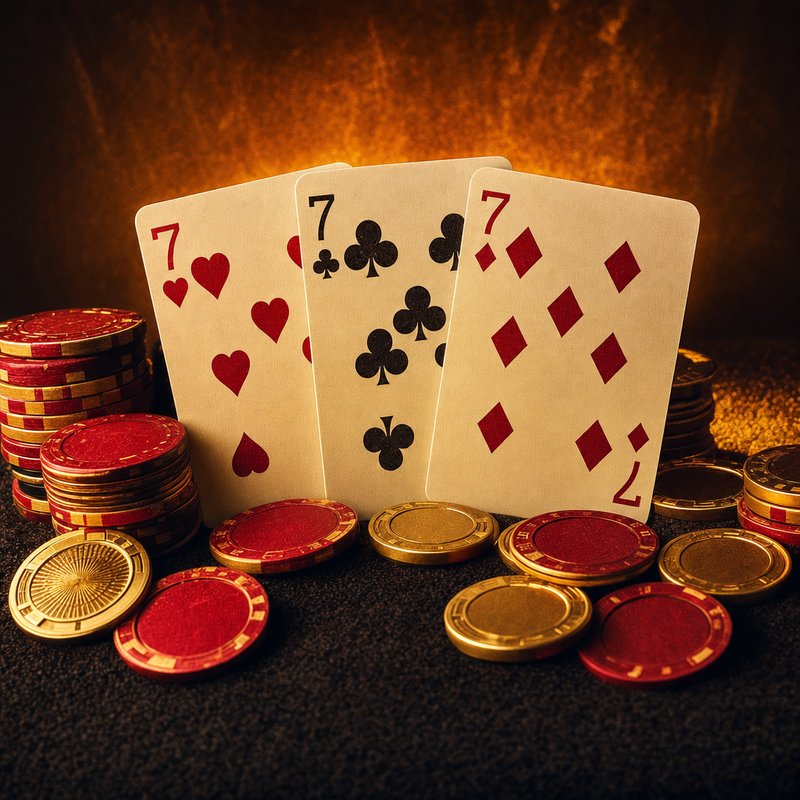
Blazing 7s payouts: the pay table and jackpot tiers
| Outcome | Pays | Notes |
|---|---|---|
| Three suited sevens | 100% of jackpot | the full progressive meter |
| Three colored sevens | 10% of jackpot | |
| Three sevens, mixed | 200 for 1 | |
| Two sevens | 25 for 1 | |
| One seven | 2 for 1 | 'for one': your wager is not returned, so this is even money |
| No sevens | Loss |
The sign is the tell. Blazing 7s tables carry a jackpot display above the felt, slot-machine style, counting upward a few cents at a time — and that display, not the pay table, is where the entire value of the bet lives. Blazing 7s blackjack is a progressive side bet on one simple event: sevens landing in your hand. One seven pays small, two pay respectably, three pay big, and three sevens in matching suits sweep whatever number the meter shows.
The bet is trademarked by Bally Gaming, which is why the name matches Bally’s most famous slot line. Bally’s table-games catalog passed into Scientific Games and then Light & Wonder, and the wager now rides on blackjack tables and their electronic progressive systems across US floors. It is blackjack furniture with slot-machine plumbing.
How the blazing 7s blackjack side bet works
You put the wager on its marked spot before the deal, commonly a fixed $1 or $5, because progressives need uniform contributions to feed the meter. Then the hand plays out and the sevens are counted.
The wrinkle is which cards count, because Bally ships two versions. In the first, the bet grades your first three cards: the two you are dealt, plus your first hit card if you take one. In the second, it grades your two cards plus the dealer’s upcard. Wizard of Odds analyzes both, and the practical difference for you is small but real: in the three-player-card version, standing on two cards means the top rungs are simply unreachable that hand, and a dealer blackjack freezes your count at two cards.
Either way, the one-seven and two-seven rungs are settled from your own first two cards alone. Land a seven on card one, and you have already won something.
That is the whole procedure. There are no decisions, no strategy chart, nothing to remember except where the third card comes from at your particular table.
The pay ladder, and what “for one” actually costs you
The standard schedule reads 2–25–200 up the ladder, with the jackpot tiers on top: three colored sevens (all red or all black) take 10% of the meter, and three suited sevens take all of it. A second published version reserves the full meter for three sevens in diamonds, pays 10% for any suited trio, and inserts a 500 fixed pay for colored sevens.
Read the felt closely, though, because every one of those numbers is “for one,” not “to one.” A 2-for-1 payout on a seven means the dealer pays you two units and keeps your bet; the net win is one unit. Even money, dressed up. The same haircut applies all the way up: the 200 rung is really 199-to-1 in the language every other side bet uses. Casinos did not choose that notation to make the sign smaller.
This matters because the surface generosity is the sales pitch. Roughly one hand in seven starts with at least one seven, so the bet pays something often enough to feel alive. What it pays is thinner than it reads.
How often the sevens actually land
The frequencies fall straight out of shoe composition, no simulation required. A six-deck shoe holds 312 cards, 24 of them sevens. Your first card is a seven about once in thirteen hands, and at least one seven appears somewhere in your first two cards roughly once in seven. That is the rung doing nearly all of the bet’s paying, and remember its payout nets you exactly one unit.
Both starting cards sevens? Once in about 176 hands. A long evening might produce one or two, and the 25-for-1 collect is where most real sessions peak. The three-seven rungs live another order of magnitude out, since a third seven must arrive from the 22 left in the shoe via your hit card or the upcard, and the jackpot tiers slice that sliver again by color and suit.
So the experience curve is steep: a small win every few minutes, a nice one every few hours, and a jackpot event you should think of the way you think of lightning. Bally engineered the rhythm deliberately. The frequent 2-for-1 taps keep chips moving and the meter fed, while the money that funds the sign comes out of every hand that shows no seven at all, which is six hands of every seven.
You are, in effect, buying raffle entries with even-money rebates attached.
What the fixed pays return: about half your money
Here is the number that should stop you. Per Wizard of Odds’ six-deck analysis, the fixed portion of the pay table (everything below the jackpot tiers) returns between 47.77% and 51.75% of the money bet, depending on version and schedule.
Sit with that for a second. Before the progressive is counted, blazing 7s blackjack keeps about half of every dollar wagered. The main blackjack game, played with basic strategy, keeps about half a cent. Even the mid-priced side bets on the full side-bet board keep five or six cents. No fixed-pay wager in the pit runs anywhere near this hot, because no other wager expects a jackpot to make up the difference.
Whether the jackpot actually makes up the difference is a question about one number on one sign.
The meter decides the house edge, so read it like a price tag
Because 48-to-52 cents of fixed return leaves an enormous gap, the bet’s real cost swings with the meter. Wizard of Odds publishes the break-even points for the six-deck game: on the common schedule, the $1 version becomes a fair bet when the jackpot reaches about $23,722, and the $5 version needs about $118,610. On the diamonds-jackpot schedule the marks sit near $97,762 and $488,812 — the top prize is rarer, so the meter must climb much further to compensate.
Those are not trivia. They are the price tag. A meter at $8,000 on a $1 table means you are playing a wager that returns well under 80 cents on the dollar; a meter at $30,000 means the casino is, at that moment, theoretically paying players to bet. It happens: progressives that go unhit long enough drift past fair value, which is why a small tribe of jackpot hunters tracks meters across town the way counters track shoes.
One practical note: the meter rises a few cents per bet made, seeded from a percentage of every wager. After a hit it resets to a base amount, and the days immediately after a reset are the worst possible time to play. The table looks identical. The math does not.
You will never compute the exact edge from your seat, and you do not need to. Compare the sign to the break-even figure for the denomination and you know which side of fair you are standing on, a luxury no fixed side bet offers.
Where it fits on the board
Judged as a steady wager, this is a donation: the fixed pays alone would make it the most expensive bet in the pit, several times the cost of Lucky Ladies and in a different universe from Lucky Lucky at under 3%. The benchmarks on the blackjack house edge page make the gap embarrassing.
Judged as a lottery ticket, it is at least an honest one. The jackpot is public, the break-even math is published, and unlike a scratch card the price of the ticket visibly improves as the meter grows. If the sevens theme is what draws you, the fixed-odds ancestor of this bet, Super Sevens with its 5,000-for-1 top rung, shows what the same idea looks like without a meter, and the comparison flatters neither.
If you want a side bet that pays often and keeps the cost measured in single digits, the value picks on the full side-bet board are a better home for your chips. If you want to sweat a five-figure number on one hand of blackjack, this is the only spot on the felt that sells it.
A note for anyone tempted by the hunting angle: progressive teams do exist, and gaming regulators from Nevada on down treat coordinated jackpot play as legal but conspicuous. A table suddenly full of $1 Blazing 7s bets the day the meter crests its break-even number tells the pit exactly what is happening, and casinos are free to cap wagers or pull the game.
Two rules if you play it casually. Check the sign against the break-even figure first, and never bet it the week after somebody’s three suited sevens put the jackpot back to its floor.