Side-bet file
Match the Dealer Blackjack Side Bet — Payouts, Odds by Deck Count
A wager that either of your first two cards matches the dealer's upcard, with suited matches paying a premium. Born at the Spanish 21 table, priced saner than most of its neighbors, and unusually sensitive to how many decks are in the shoe.
Published Tuesday, June 30, 2026 · 11 min read
Match the Dealer payouts: the six-deck pay table
| Outcome | Pays | Notes |
|---|---|---|
| Suited match (rank and suit) | 11:1 | per matching card |
| Unsuited match (rank only) | 4:1 | per matching card |
| Two suited matches | 22:1 | both cards pay their rung; mixed combos add up the same way |
| No match | Loss |
Some side bets sell a jackpot. This one sells a coincidence. Match the dealer blackjack pays when either of your first two cards matches the dealer’s upcard in rank, a nine meeting a nine, with a premium when the match extends to suit. No ladders to 1000:1, no progressive meter, just a clean little echo between your hand and the dealer’s card.
The wager earned its spot on the felt honestly: it comes from the Spanish 21 table, it’s priced saner than most of its neighbors, and its pay table does something almost no other side bet bothers to do. It tells the truth about deck count, out loud, in print.
How the match the dealer blackjack side bet works
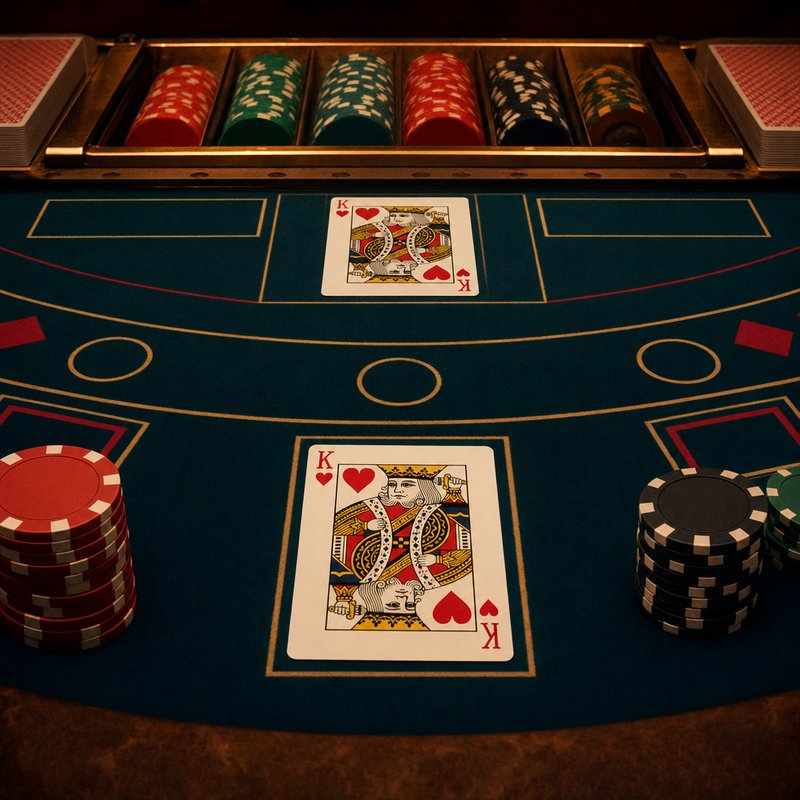
Chips go on the match spot before the deal, alongside a live main bet. Once the upcard shows, the grading takes two seconds: each of your two cards is compared with the upcard independently, every rank match pays the low rung, every rank-and-suit match pays the high rung, and the results add. Two matches collect twice. No match, and the chips are gone before your blackjack hand makes its first decision.
A worked example makes the stacking concrete. Say the felt posts 4:1 and 11:1 and the dealer turns a seven of diamonds. If you hold the seven of clubs, that’s one unsuited match: 4:1. Seven of clubs and seven of hearts: two unsuited matches, 8:1 combined. Seven of clubs with the seven of diamonds’ twin from another deck: one of each, 15:1. Both cards duplicating the exact seven of diamonds pays the full 22:1, and yes, the multi-deck shoe makes that legal.
That per-card stacking distinguishes it from the pair-hunting family. Where Perfect Pairs needs your own two cards to mirror each other, this bet points outward at the dealer, and a hand like nine-nine against a dealer nine is the dream scenario: two matches, both paid, plus a splittable main hand.
At six decks the standard schedule pays 4:1 unsuited and 11:1 suited per match, which Wizard of Odds prices at a 4.06% house edge. The match the dealer odds of collecting something land near one hand in seven, with single unsuited matches doing nearly all the winning. It’s a frequent-small-win bet by design: steady enough to feel alive, cheap enough per rung that the house keeps its margin without a billboard number.
Match the dealer payouts by deck count
Here’s the unusual part. Most side bets pretend deck count doesn’t exist. This one reprices itself openly, because the probability of duplicating the upcard’s exact card moves sharply with the number of decks in the shoe. The posted schedules, per Wizard of Odds:
| Decks | Unsuited match | Suited match | House edge |
|---|---|---|---|
| 2 | 4:1 | 19:1 | 3.31% |
| 4 | 4:1 | 12:1 | 4.84% |
| 5 | 3:1 | 15:1 | 4.76% |
| 6 | 4:1 | 11:1 | 4.06% |
| 8 | 3:1 | 14:1 | 3.67% |
Two things jump out of that table. First, the suited rung collapses as decks are added, 19:1 at two decks down to 11:1 at six, because extra decks multiply the copies of the exact suited card available to match. Second, the edge doesn’t move in a straight line: two decks is the cheapest seat in the family and four decks the priciest, purely because of how each schedule rounds its pays. The match the dealer payout structure rewards players who read the felt instead of assuming.
So the shopping rule writes itself. At a two-deck game this is one of the best-priced side bets in the building; at a four- or five-deck game the identical-looking bet costs half again as much. Few players carry that map in their heads, which is precisely why it’s worth carrying: the felt reprices honestly, but it never explains itself, and the pit isn’t going to volunteer that the shoe two tables over sells the same coincidence at a discount.
One warning applies everywhere: those numbers are the standard schedules. House-modified versions circulate, and a table paying 3:1/12:1 at six decks is quietly charging more than the felt’s cousins. When in doubt, the printed pair on the layout is the bet you’re actually buying, and thirty seconds of comparison against the table above tells you whether it’s the honest edition.
Match the dealer odds: where the money leaks
Run the six-deck version through the grinder and the shape is familiar. About 86% of hands produce no match and lose instantly. Most wins are one unsuited match at 4:1, pleasant rather than thrilling. The suited match arrives occasionally, and the 22:1 double suited match is rare enough to be a story you’ll retell.
Total damage at six decks: 4.06%, or about 20 cents per $5 bet per round in expectation, which works out to roughly twelve dollars an hour at a full-speed sixty-hand table. That’s genuinely cheap for the category. Compare the full side-bet board and you’ll find only the 21+3 wager consistently undercutting it among the big names, while the ten-based jackpot bets charge four to six times as much. The house edge rankings put the whole hierarchy in one column if you want the receipts.
Notice also what the bet doesn’t do. There is no rung engineered to be nearly unhittable, no progressive meter, no envy bonus, none of the machinery casinos use to hide a fat margin behind a rare thrill. The worst outcome is losing one small bet fast, and the best outcome is 22 units, close enough to reachable that the felt doesn’t need a billboard. Structurally, this is one of the most honest wagers in the pit.
And for the counters: there’s no angle here. The bet turns on rank duplication, not ten-density, so standard counts are blind to it, and no practical system tracks the shoe finely enough to matter. Uncountable, in the way that keeps a bet spread widely and unwatched.
You could do worse. Most people at the table are doing worse.
Sizing deserves one paragraph of its own, because the bet’s steady rhythm invites creep. A wager that pays something every seven hands feels like it’s carrying its weight, and players who started with a dollar on the spot drift to five without noticing the hourly bill quintupling with them. The discipline is the same one this site prescribes everywhere: keep the side wager to a tenth of your main bet, treat every payout as borrowed rather than earned, and if the match spot ever holds more than the betting circle behind it, you’ve stopped playing blackjack and started playing the sideshow at eight times the price.
The Spanish 21 heritage
Match the Dealer didn’t start as a blackjack bet. It grew up attached to Spanish 21, Masque Publishing’s stripped-deck game, where every ten is removed from the shoe leaving 48-card decks of face cards and spot cards. The side bet was part of that table’s furniture, and its math benefits from the strip: fewer distinct cards means rank matches come slightly easier, and Wizard of Odds has the Spanish 21 versions running near 3%, paying 4:1/9:1 at six 48-card decks, modestly friendlier than the blackjack ports.
When Spanish 21’s popularity crested, the side bet outgrew its host. Casinos found that the mechanic needed nothing from the Spanish rules, no ten-stripping and no bonus 21s, so it was grafted onto ordinary shoes with retuned pay tables, and today plenty of players who’ve never seen a Spanish 21 layout know the match spot well. The bet also travels under house names on some felts, but the grading is always the same: your two cards, the upcard, rank and suit.
There’s a small irony in the migration. Spanish 21 removes tens, which raises the main game’s difficulty while sweetening this side bet; standard blackjack keeps its tens and trims the match pays instead. Either way the wager stays in the same price band, which says something about how deliberately Masque’s math held up across three decades of porting.
If you take one habit from this page, take the deck-count check. Glance at the shoe, glance at the posted pair of numbers, and know within a percent what match the dealer blackjack costs before your chips commit. Two decks with 19:1 suited: reasonable entertainment. Four decks at 12:1: walk. The dealer will still be there to match either way.