Side-bet file
Kings Bounty Blackjack Side Bet — Full Pay Table and Real House Edge
A wager on being dealt exactly 20, with a ladder that climbs from any 20 at 4:1 to twin kings of spades against a dealer blackjack at 1,000:1. The filed pay table, the math behind it, and why the price is brutal.
Published Thursday, May 14, 2026 · 9 min read
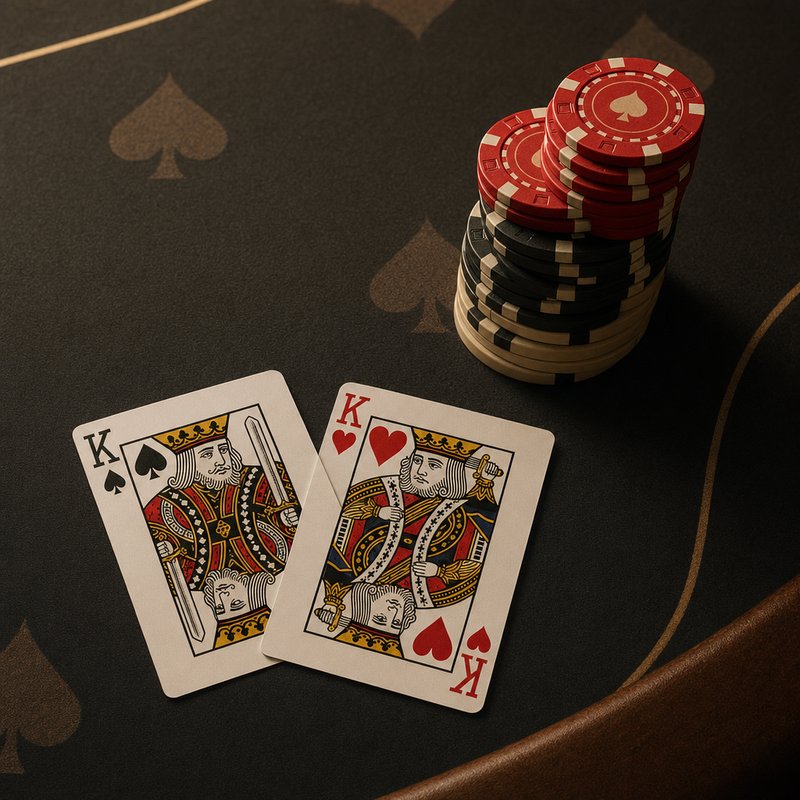
King's Bounty payouts: every rung of the pay table
| Outcome | Pays | Notes |
|---|---|---|
| Pair of kings of spades + dealer blackjack | 1,000:1 | both events must land on the same hand |
| Pair of kings of spades | 100:1 | |
| Pair of kings, same suit | 30:1 | |
| Pair of 10s, jacks or queens, same suit | 20:1 | |
| Suited total of 20 | 9:1 | |
| Pair of kings, mixed suits | 6:1 | |
| Any total of 20 | 4:1 | |
| Anything else | Loss |
Twenty is the second-best hand in blackjack and the most anticlimactic: you stand, you usually win, nothing happens. King’s Bounty exists to sell drama on top of that anticlimax. The kings bounty blackjack side bet pays whenever your first two cards total exactly 20, and it grades the quality of the 20, with a ladder that starts at 4:1 for a garden-variety queen-ten and tops out at 1,000:1 when two kings of spades arrive just as the dealer turns over a blackjack.
The bet circulates through the Scientific Games catalog, now Light & Wonder, and shows up from Québec’s government casinos, whose filed rule sheet provides the pay table on this page, to tribal floors in California. Signage spells it King’s Bounty; players searching for it drop the apostrophe, and either way it is the same wager.
How the kings bounty blackjack side bet works
Place the wager on the marked spot before the first card leaves the shoe. Some tables let you play it without a main bet; most require one alongside. From there the resolution takes two seconds: the dealer looks at your first two cards, and if they total 20, you get paid the highest single rung your hand matches. Anything other than 20 loses on the spot.
Note the phrase highest single rung. A pair of spade kings is also a suited pair of kings, also a suited 20, also a 20, but you collect 100:1 once, not four payouts stacked. The filed Québec rules state this explicitly, and every US installation follows the same convention.
Aces play no special role here. Ace-nine totals 20 and qualifies for the bottom rung; a blackjack, ace plus ten, totals 21 and loses the side bet outright. Being dealt too good a hand for the wager you just made is this bet’s signature small cruelty.
The top rung has one more moving part: the dealer. Kings of spades pay 100:1 on their own, and 1,000:1 only when the dealer’s hand happens to be a blackjack on the same deal. Everything below that line settles without the dealer’s cards mattering at all.
Reading the ladder: where the money actually sits
The rungs sort into three tiers of reality.
The rung you will actually hit. Two-card 20s arrive a little more often than one hand in ten, and the overwhelming majority are unsuited, non-paired combinations: queen-ten, king-jack offsuit, ace-nine. All of them pay 4:1. This is the bet’s engine room, and 4:1 on a roughly 10% event is exactly where the house builds its margin.
The rungs you will hit occasionally. Suited 20s at 9:1 and mixed kings at 6:1 come around often enough to remember. The suited pairs at 20:1 and 30:1 need both cards from the same six-card pocket of a six-deck shoe. You will see them; you will not retire on them.
The billboard. Kings of spades, 100:1, is dealt when both of your first two cards come from the six copies of one exact card in the shoe. The 1,000:1 version then also needs the dealer to be sitting on the roughly one-in-21 blackjack at the same moment. Multiply those and you understand why the casino can paint a comma on the sign: the compound event is measured in tens of thousands of hands.
One quiet detail worth respecting: because only the top rung involves the dealer, this is one of the few side bets where a dealer blackjack is your best-case scenario instead of your worst.
What a session actually feels like
Translate the frequencies into an evening and the bet’s character comes through. Play a hundred hands with a kings bounty blackjack wager on each, and you should expect ten or eleven winners, nine of them at the bottom 4:1 rung, with perhaps one suited 20 sweetening the mix. Droughts of twenty or thirty hands without a single 20 are routine, not bad luck.
That cadence is gentler than the jackpot bets and harsher than the totals-based family. Something pays about once a shoe.
The paired rungs supply the memorable moments at realistic intervals: mixed kings every hundred-some hands, a suited pair of paint every few hundred, spade kings once in the multiple thousands. Regular players genuinely do see the 100:1 rung eventually, which is more than the top of most ladders can claim, and it is exactly this see-it-someday reachability that keeps the wager circulating.
What the cadence conceals is the leak. Ten winners per hundred hands, mostly at 4:1, hand back around forty units against the ninety that the losing hands cost, and the occasional mid-ladder hit patches only part of the remainder. The gap, hand after hand, is the 23%. Nothing about the experience feels like losing a quarter of your action, and that disconnect between texture and price is precisely what the bet is engineered to produce.
Wizard of Odds, the standard reference for side-bet math, does not carry a King’s Bounty page, so there is no canonical published edge. The pay table, though, is public, and the combinatorics are straightforward: in a six-deck shoe, tally every two-card 20, weight each rung by its filed payout, fold in the dealer-blackjack chance on the spade-kings tier, and the schedule returns roughly 77 cents per dollar. Call it a house edge of about 23%, with posted tables varying a point or two either side.
That number deserves a comparison to land. Basic-strategy blackjack costs about 0.5%. Buster Blackjack costs 5-6%. The strong value picks near 3% are catalogued on the blackjack house edge page, and on the full side-bet board this wager props up the expensive end. King’s Bounty costs more than nearly everything above it combined: a $5 wager every hand donates well over a dollar per round in expectation.
Why does anyone play it? Because the bet hits often enough to feel generous. One in ten hands, chips come back, and the brain files the wager under “pays sometimes” rather than “keeps 23%.” The rung doing the paying and the rung on the billboard are two different rungs, and the distance between them is the price of the show.
Kings Bounty vs Lucky Ladies: two tickets to the same raffle
The natural comparison is Lucky Ladies, the older and more widespread pays-on-20 wager. The skeleton is identical: two cards, total of 20, ladder graded by glamour. The difference is the theme. Lucky Ladies crowns the queen of hearts, pays its jackpot for a matched pair of them (against a dealer blackjack in the common version), and typically runs a house edge north of 20%; King’s Bounty crowns the spade king, adds more suited rungs in the middle of its ladder, and lands in the same bracket by our math above.
Neither is a better deal. They are the same deal in different costume, and both illustrate the pattern that governs the whole 20-based family: any side bet whose most common win pays 4:1 against a one-in-ten event has already told you who profits, before you read a single upper rung.
If the format appeals but the price does not, the pair-based wagers reviewed under Perfect Pairs scratch a similar itch, cheaper.
If you play it anyway
Some nights the story wins and the spreadsheet loses. Fine. Play it like what it is.
Keep it occasional rather than every hand, because a 23% edge compounds brutally with volume. Size it at a dollar or two, not a fraction of your main bet, since no main-bet logic applies to a raffle ticket. And check the felt before you commit: this wager has no single standardized schedule, and a table paying 5:1 on the bottom rung instead of 4:1 is meaningfully less bad, while one shaving the suited rungs is worse than everything computed here.
Two smaller table rules earn a mention. Some installations allow the side bet without a main wager, per the filed Québec rules, which matters only to someone treating it as a pure raffle. And the bet reads your first two cards only: split those kings and draw two more, and the side money was settled before the split existed.
The last word belongs to the top of the ladder. Two kings of spades with a dealer ace-ten waiting is a genuine casino unicorn, and if it ever happens to you, the table will talk about it for a week. You will have paid for the privilege many times over by then. The felt never mentions that part.