Side-bet file
Perfect Pairs Blackjack Side Bet — Payouts, Tiers and House Edge
Three rungs of the same idea: your first two cards share a rank, a color, or the whole identity. The pay tables look interchangeable and price out wildly differently, and the number of decks in the shoe matters more than any of them.
Published Tuesday, June 2, 2026 · 10 min read
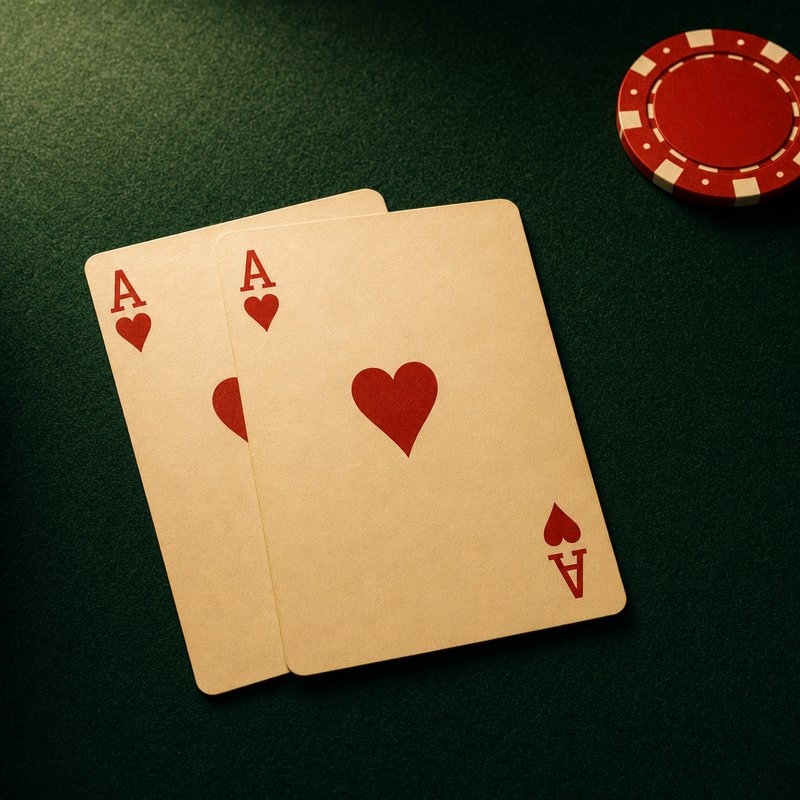
Perfect Pairs payouts: the three tiers
| Outcome | Pays | Notes |
|---|---|---|
| Perfect pair (identical rank and suit) | 25:1 | only possible with multiple decks |
| Colored pair (same rank, same color) | 12:1 | e.g. king of spades + king of clubs |
| Mixed pair (same rank, different color) | 6:1 | |
| No pair | Loss |
Twins pay in this corner of the felt. Perfect pairs blackjack is a side bet on your first two cards forming a pair, and it grades the pair like a jeweler grades stones: same rank in mixed colors earns the small rung, same rank and color earns the middle one, and two literally identical cards, rank and suit both, collect the 25:1 or 30:1 that gives the bet its name.
It looks like the simplest wager in the pit. It’s actually the one where the fine print swings hardest, because two levers the casual player never checks, the posted tiers and the number of decks, move its price across a fourfold range.
How perfect pairs blackjack works
The bet goes down before the deal, beside a live main wager, and resolves the instant your two cards land. The dealer’s hand is irrelevant; so is everything you do afterward. Either your cards share a rank or they don’t, and if they do, the suit relationship sets the payout rung.
The three tiers are strict. A mixed pair means same rank, opposite colors: king of spades with king of hearts. A colored pair keeps the color but not the suit: king of spades with king of clubs. A perfect pair is the full twin, king of spades with king of spades, which can only happen because six or eight decks are shuffled together. On the common schedule those pay 6:1, 12:1 and 25:1 respectively.
Because the wager settles before any play begins, it has a peculiar social rhythm at a live table. Wins announce themselves the instant the cards land, before anyone has hit or stood, and a paid perfect pair often outearns the main bet it was riding beside. Then the hand itself begins, and your pair of eights still has to be played as a pair of eights.
That last point matters, because the side bet and the main game share cards but not logic. Basic strategy doesn’t move an inch for the wager: a pair of eights still splits against a ten, a pair of fives is still a double waiting to happen, and no payout already collected should change how you play the hand underneath. Players who let a 25:1 windfall talk them into a hero split are handing back the win. The two bets coexist on the same felt and otherwise ignore each other completely.
The odds, tier by tier
The arithmetic behind the rungs is clean enough to do on a napkin, and worth doing once. At eight decks, after your first card is dealt, 415 cards remain unseen. Seven of them are exact copies of your card, eight more share its rank and color without matching the suit, and sixteen share the rank in the opposite color. Stack those up:
| Outcome | Qualifying cards of 415 | Rough odds |
|---|---|---|
| Perfect pair | 7 | 1 in 59 |
| Colored pair | 8 | 1 in 52 |
| Mixed pair | 16 | 1 in 26 |
| Any pair | 31 | 1 in 13 |
Two lessons live in that table. First, mixed pairs are the volume business: half of all pairs you’ll ever be dealt are the cheap kind, which is why the bottom rung’s payout matters far more than its size suggests. Second, the perfect pair is reachable but genuinely uncommon — a once-an-evening event for a steady player, not a once-a-year one. The bet’s feel comes from that spacing: regular small hits, occasional real ones, and a session of a few hundred hands that usually delivers at least one of the good kind. That cadence is the retention mechanism doing its job, and it’s worth recognizing as engineering rather than luck.
Those denominators also explain the pricing pressure on each rung. A 25:1 payout against 1-in-59 odds keeps less than half the rung’s fair value away from you; the house recovers its margin on the frequent rungs, where a unit trimmed off the mixed-pair payout does quiet, constant work.
The pay tables: same tiers, very different prices
Casinos shuffle the three payout numbers like a shell game, and Wizard of Odds has priced the common eight-deck arrangements. The spread deserves a table of its own:
| Schedule (mixed/colored/perfect) | House edge, 8 decks |
|---|---|
| 5 / 15 / 25 | 2.17% |
| 6 / 12 / 25 | 4.10% |
| 5 / 10 / 30 | 3.37% |
| 5 / 12 / 25 | 7.95% |
Look at the last two rows. Moving two units between the middle rungs, 5/12/25 versus 5/10/30, more than doubles the cost of the bet, because the colored pair actually arrives often enough to matter while the perfect pair mostly decorates the felt. The schedules are engineered to look interchangeable at a glance. They are not, and the 7.95% table is counting on you not doing this arithmetic mid-pit.
The shopping rule compresses to one sentence: the middle number is the one that pays your real wins, so buy the biggest middle number you can find. A 15 in that slot is the best signal the felt can send you, a 10 is a warning, and the top number is mostly decoration either way.
Online adds its own wrinkle. Evolution’s live-dealer version, standard equipment next to the 21+3 side bet on most streams, pays 25:1 for one perfect pair with a 200:1 flourish for two, and runs 8.05% per the same source. The convenience of the toggle costs roughly double the good floor game, a markup worth knowing about before it becomes a habit.
House edge: why the deck count decides everything
Every number above assumes eight decks, and that assumption is load-bearing. Pairs need duplicates, and duplicates are exactly what extra decks provide. Shrink the shoe and the bet starves: at two decks only one perfect twin of your first card exists anywhere, in a single deck the perfect pair is flat-out impossible, and even mixed pairs thin noticeably. Since posted schedules rarely improve to compensate, the identical felt costs several points more at low deck counts, sliding toward the range where this bet keeps company with the genuinely ugly wagers.
That inversion trips up players trained on main-game instincts, where fewer decks are the prize. Here the logic runs backward. An eight-deck shoe, normally the grind you tolerate, is where perfect pairs blackjack is cheapest; the cozy double-deck pitch game is where it quietly bleeds you. If a casino deals the bet on a double-deck layout at all, assume the price has drifted well past anything in the table above, because the twin your top rung depends on barely exists in that shoe.
For calibration against the rest of the category: the good 8-deck schedules at 2–4% sit near the cheap end of the full side-bet board, in the same band as the better-behaved bets and far from the 17%-plus that Lucky Ladies charges for its queens. The stingy schedules erase that advantage completely. Both wear the same name.
One more null result, for completeness: there’s no counting angle. The bet pays across all thirteen ranks, ten-density counts can’t see it, and no practical system tracks rank duplication deeply enough to matter. That neutrality has a quiet upside, since a wager the house can’t be beaten on is a wager the house never watches, and nobody at the perfect pairs spot is getting a second look from surveillance.
Should you play it?
Here’s the direct answer: on a 5/15/25 or 6/12/25 schedule at a full shoe, perfect pairs is a reasonable entertainment purchase, a couple of dimes per $5 bet per round in expected cost with a satisfying once-an-hour hit rate on the pair rungs. On a 5/12/25 table, or any table where the shoe runs short, skip it without a second look. Same bet, double the price, and nobody at the table will warn you.
The habit that protects you takes five seconds. Before the first chip lands, read the three numbers off the felt, note the middle one, and count the decks in the shoe. High middle number, big shoe: play it small if the mood strikes. Anything else, and your pair of eights of hearts is just a pretty way to fund the chandeliers — the house edge rankings show exactly where each version of that decision lands.