Side-bet file
Lucky Lucky Blackjack Side Bet — Payouts, Odds and the Low House Edge
Three cards, yours plus the dealer's upcard, paying on totals of 19 through 21 and the sevens combinations above them. On its best schedule this is the cheapest side bet on the felt, and the numbers prove it.
Published Saturday, June 6, 2026 · 9 min read
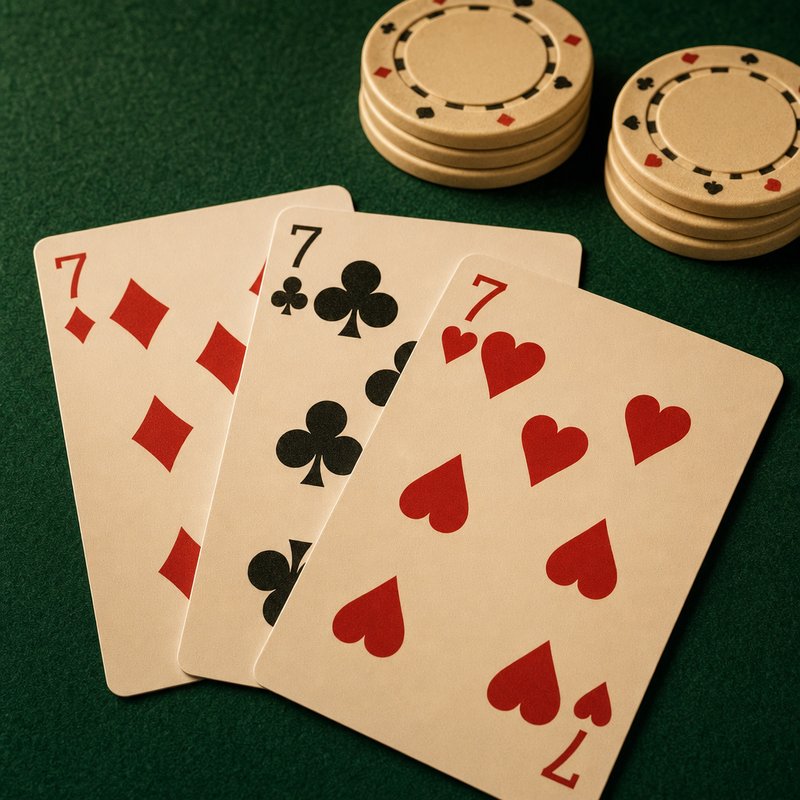
Lucky Lucky payouts: the full pay table
| Outcome | Pays | Notes |
|---|---|---|
| Suited 7-7-7 | 200:1 | all three sevens in one suit |
| Suited 6-7-8 | 100:1 | |
| Unsuited 7-7-7 | 50:1 | |
| Unsuited 6-7-8 | 30:1 | |
| Suited total of 21 | 15:1 | |
| Unsuited total of 21 | 3:1 | the workhorse rung |
| Total of 20 | 2:1 | |
| Total of 19 | 2:1 | |
| 18 or less, 22 or more | Loss |
Every side bet on the felt sells the same product, a small stake on a long shot, and almost all of them overcharge for it. Lucky lucky blackjack is the exception worth knowing by name. It grades three cards, your first two plus the dealer’s upcard, pays on totals of 19 through 21, and on its full schedule costs 2.66% per Wizard of Odds. In a category where 6% is respectable and 20% is common, that number makes it the cheapest genuine side bet in wide circulation.
Wizard of Odds also gives it a historical footnote: this was the first side bet built on the player-two-cards-plus-upcard formula, the template that Hot 3, Bust Bonus and half the modern board later borrowed. The original turns out to still be the best-priced of the family.
How the lucky lucky blackjack side bet works
Chips go on the marked spot before the deal, next to your main bet. The moment your two cards land and the dealer’s upcard flips, the bet is over: the three cards are summed, aces flexing between one and eleven just as in the main game, and the highest matching rung pays.
The resolution speed matters more than it sounds. Because the wager settles before you make a single playing decision, it never interferes with strategy, never tempts you to hit or stand differently, and never leaves you sweating the dealer’s hole card. Whatever happens to your main bet afterward is a separate story.
A quarter of the time, roughly, the story starts with a payout.
The rungs stack by rarity. Totals of 19 and 20 pay 2:1 on the full schedule and account for most wins. An unsuited 21 pays 3:1 and a suited one 15:1. Above them sit the theme rungs: 6-7-8 and 7-7-7, each in unsuited and suited versions, climbing from 30:1 to the 200:1 crown for three sevens in one suit. Only the best rung pays; a suited 7-7-7 is not also collecting the 21 money.
Eight pay tables, one worth playing
Here is where you earn your 2.66%, because casinos do not all post the same felt. Wizard of Odds documents eight published Lucky Lucky schedules, and the differences hide in two spots most players never check: the 19 rung and the suited-21 rung.
| Rung | Full schedule (PT1) | Common trims |
|---|---|---|
| Total of 19 | 2:1 | 1:1 |
| Total of 20 | 2:1 | 2:1 |
| Unsuited 21 | 3:1 | 3:1 or 2:1 |
| Suited 21 | 15:1 | 10:1 or 3:1 |
| Unsuited 6-7-8 | 30:1 | 25:1 or 10:1 |
| Unsuited 7-7-7 | 50:1 | 30:1 |
| Suited 6-7-8 | 100:1 | 50:1 |
| Suited 7-7-7 | 200:1 | 100:1 or 500:1 |
Per the Wizard of Odds six-deck analysis, the full schedule returns 97.34 cents on the dollar; the trimmed versions run from about 3.95% up to 7.91% house edge, with one 500:1-topped variant costing around 7% because it guts every rung below the billboard to fund it. Same name on the felt, double or triple the price.
The tell is the 19 rung. If 19 pays 2:1, you are probably looking at the full schedule; if it pays even money, the casino ordered a cheaper felt and you are subsidizing the difference. Online, the picture is similar: Wizard of Odds notes that internet casinos on Felt Gaming software deal a mid-grade schedule at just under 5%.
Deck count barely moves any of this. The published spread from one to eight decks is a few tenths of a percent, noise next to the pay-table decision.
Where the 6-7-8 and 7-7-7 rungs come from
The theme rungs deserve a paragraph, because they are what separates this bet from a plain totals wager. Both featured combinations sum to 21, so they would already collect the 3:1 rung; the schedule promotes them to 30:1 and beyond purely for their shape. 7-7-7 is blackjack’s oldest talisman, borrowed straight from slot-machine iconography, and 6-7-8 is the tidiest run to 21 the deck can produce. Neither is rarer than the pay difference implies on its own; the premium is theater, funded by trimming elsewhere.
The suited versions are another story. Three specific-suit cards from a six-deck shoe multiply the rarity enough that 100:1 and 200:1 are honestly priced rungs rather than billboard bait, which you can verify from the fact that the full schedule still returns over 97% with them included.
One quirk follows from the ace’s flexibility: ace-ace-nine and similar soft combinations read as 21, so hands that look like nothing on the felt sometimes collect the 3:1 rung. Dealers occasionally miss these. Count your own three cards.
Why 2.66% makes it the value pick
Numbers need neighbors to mean anything, so line them up. The main blackjack game with basic strategy costs about 0.5%. Lucky Lucky’s full schedule costs 2.66%. 21+3 runs near 4% on its common version. Buster Blackjack sits at 5-6%, Hot 3 at 5.4%, Perfect Pairs anywhere from 5% to 11% by schedule, and the pays-on-20 jackpot family north of 20%. The complete rankings live on the full side-bet board, and nothing else with real distribution beats this bet’s price.
Frequency is the other half of the value case. A bet that hits a quarter of the time and mostly pays 2:1 behaves like a gentle amusement, not a slot machine bolted to the felt. Your bankroll’s variance stays low, the wins arrive often enough to keep the wager fun, and the long-shot rungs still exist for the nights the shoe turns theatrical.
Be clear about what 2.66% is, though: the best price in a shop where everything is marked up. A $5 Lucky Lucky every hand still costs about 13 cents a round in expectation, five times the toll of the main game. Cheapest is not free.
What it costs across a real session
Say you play $5 of lucky lucky blackjack on every hand at a 70-hand-per-hour table. On the full schedule that is $350 in side-bet action costing about $9.30 in expected loss for the hour. The same habit on a trimmed 7.9% felt costs roughly $27.65. One glance at the 19 rung before sitting down is worth eighteen dollars an hour; almost nothing else in the pit pays that well for five seconds of reading.
The comparison to skip: putting those same chips on the main bet instead costs under $2 an hour at basic-strategy accuracy, a benchmark the blackjack house edge page unpacks rung by rung. Every side bet is a markup on that baseline; this one is simply the smallest markup on the shelf, and it stays a markup.
Counting deserves a sentence, because this bet is famously count-sensitive. The premium rungs live on sevens, and a shoe rich in sevens, sixes, eights and aces can push the full schedule past break-even. Published side-count systems exist for it, and they are the reason some pits cap Lucky Lucky wagers or quietly swap in trimmed felts. If your interest runs that direction, understand you will be sweating a small, occasional edge for real scrutiny.
Playing it without ruining the math
Three habits keep the value pick valuable. Read the felt first, and walk past any table paying even money on 19. Size the bet at a fraction of your main wager, because 2.66% compounds like any other cost. And resist the upgrade instinct: pressing the side bet after a couple of hits does not chase anything real, since every hand’s odds reset with the shuffle.
The bet’s one honest weakness is its ceiling. Nothing on this schedule changes your night the way a progressive’s meter can, and if you play side bets specifically for the lottery moment, 200:1 may read as modest. That is the trade. Lucky Lucky charges the least of any wager on the board precisely because it promises the least, and the suited sevens still pay for a very good dinner.
A final word on availability, since the bet’s biggest practical problem is finding its best version. Distribution is wide across US floors, but the felt a casino orders tends to track its overall side-bet posture, and pits that trimmed their other schedules usually trimmed this one too. When you find a true full-schedule table, that is worth remembering.
The name on the felt is doubled for marketing, not math. The math, for once, holds up on its own.