Side-bet file
Lucky Ladies Blackjack Side Bet — Payouts, Odds and House Edge
A wager on one thing: your first two cards totaling 20. The queen of hearts headlines, the 1000:1 rung sells it, and the math underneath is the steepest on the felt. Here is the whole story, counting angle included.
Published Monday, June 29, 2026 · 12 min read
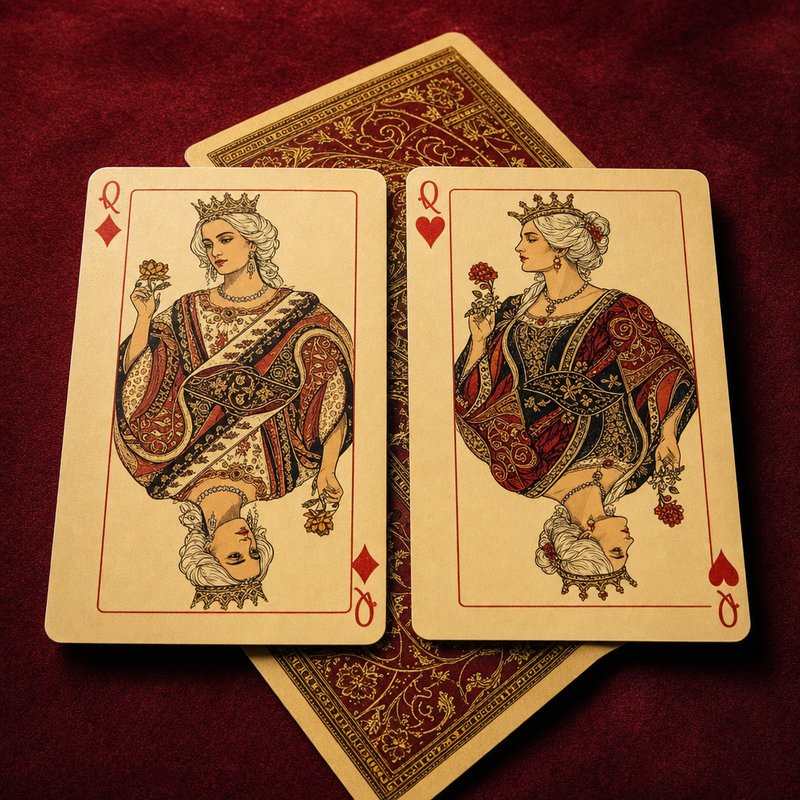
Lucky Ladies payouts: the full pay table
| Outcome | Pays | Notes |
|---|---|---|
| Queens of hearts pair + dealer blackjack | 1000:1 | the billboard rung, three rare events at once |
| Queens of hearts pair | 125:1 | 200:1 on the alternate schedule |
| Matched 20 | 19:1 | same rank and suit, e.g. two kings of spades |
| Suited 20 | 9:1 | |
| Any unsuited 20 | 4:1 | the rung that pays most of the wins |
| Anything but 20 | Loss | a blackjack is 21, so it loses |
Every pit has one bet that pays for the chandeliers, and in most American rooms it’s this one. Lucky ladies blackjack is a side wager on a single clean event, your first two cards totaling exactly 20, dressed up with a queen-of-hearts theme and a 1000:1 headline. It is the most expensive standard side bet in the game by a wide margin.
It is also, by a strange twist of the same math, the one side bet that skilled players have genuinely beaten. Both facts come from the same place: tens.
How the lucky ladies blackjack side bet works
You place the lucky ladies blackjack side bet before the deal, next to a live main bet. If your first two cards total 20, you’re paid by how ornate the 20 is; any other total loses on the spot. The dealer’s hand is irrelevant to every rung except the top one, where a pair of queens of hearts combines with a dealer blackjack for the jackpot payout.
The bet started in Washington state card rooms, per Wizard of Odds, and spread nationwide through Galaxy Gaming’s side-bet catalog until the pink queen logo became furniture in tribal and commercial casinos alike. The procedure could not be simpler. There are no decisions, no timing, nothing to remember, which is part of the design, because simplicity keeps chips landing on the spot.
One rule surprises new players every night: a blackjack loses. Ace-ten is 21, not 20, so the felt’s luckiest hand collects on the main bet while the side bet is swept. The wager is literal to the point of cruelty, and the dealer will not warn you.
Lucky ladies payouts: five rungs and a queen of hearts
The common six-deck schedule pays 4:1 on any unsuited 20, 9:1 suited, 19:1 for a matched 20 of identical rank and suit, 125:1 for the pair of queens of hearts, and 1000:1 when those queens meet a dealer blackjack. An alternate schedule sweetens the middle to 10:1, 25:1 and 200:1. Cheaper cousins exist too: versions paying 3:1 on any 20 with a 1:1 consolation for a single queen run a far milder 5.9 to 6.2% edge, per the same source, precisely because they’ve amputated the jackpot romance.
Notice the architecture. Nearly every win you’ll actually experience is the 4:1 rung, because unsuited 20s dwarf all other qualifying hands combined. The lucky ladies payout ladder above it exists mostly as advertising: the matched 20 is a novelty, the 125:1 queens arrive about once in 3,300 hands of a six-deck shoe, and the 1000:1 rung, queens of hearts meeting a dealer ace-ten on the same deal, is a once-per-career event for most dealers, let alone players.
Advertising works, though. The number 1000 does heavy lifting on that felt, and the low-edge 3:1 versions that dropped it never achieved a fraction of the classic schedule’s spread. Casinos learned the lesson and kept the queen.
For completeness, the family also includes progressive editions. Wizard of Odds notes Bonus Lucky Ladies and a further schedule that wire the top hands to a variable jackpot meter instead of a fixed 1000:1, which makes their true price depend on the meter’s height on the day you play. The structure is the same trade in a different wrapper: an even rarer top event funding an even steeper base cost, with the added twist that the posted felt can’t tell you what the bet is currently worth.
Lucky ladies odds and the steepest house edge in the pit
Here is the part the rack card omits. Two-card 20s just aren’t rare enough to justify the schedule: they arrive roughly once per ten hands, almost always in the humble unsuited form, and 4:1 on a one-in-ten event is a brutal exchange. Stack the rungs together and Wizard of Odds prices the common six-deck version at a 24.71% house edge, with the friendlier alternate at 17.64%.
Sit with those numbers. A $5 lucky ladies chip every hand costs you about $1.10 to $1.25 per round in expectation, which at a 60-hand-per-hour table is roughly seventy dollars an hour surrendered to a mascot. That’s twenty-plus times the price of the main game underneath, and several times the price of any respectable neighbor on the full side-bet board. The 21+3 wager runs under 4%. Even the flashy dealer-bust bets stay near 6%. Nothing else in wide circulation comes close to lucky ladies territory, a fact you can verify against every number in the house edge rankings.
Deck count makes it worse in the wrong direction. The same schedule that costs 24.71% over six decks costs 30.05% over two, because matched pairs and ten-density both suffer as decks come out. The single-deck variant sold for pitch games runs about 30% as well, and even the eight-deck version only softens to 24.05%. There is no version of this table where fewer decks help you, and no version where more decks help you enough.
Call it what the math calls it: at full price, lucky ladies blackjack is a donation with a theme song.
The most countable side bet on the felt
Now the twist. The same ten-dependence that makes the base bet horrific makes it the most exploitable side wager ever widely spread. The bet pays on 20s; 20s are two ten-value cards; and the density of ten-value cards remaining is precisely what every standard counting system tracks, which is why the lucky ladies odds are not fixed the way most side bets are. When a shoe goes deeply ten-rich, the lucky ladies odds improve so sharply that the bet flips positive — not marginally, but by edges that dwarf what counters earn on the main game in the same moments.
Think about why the effect is so violent. A bet that needs two specific card types to land on the same deal responds to composition changes quadratically, not linearly. Push the ten concentration up by a quarter and the frequency of two-ten hands rises by more than half, while the pay table stays bolted to the felt. No main-game wager concentrates its sensitivity like that, which is why a bet that costs 24.71% off the top can still hand a patient counter the best single-shoe opportunities in the building.
This is documented territory, not forum legend. Counting literature has treated the bet as the canonical beatable side wager for two decades, and casinos absorbed the lesson: the wager carries low table maximums, and surveillance reads a sudden lucky ladies bet from a previously abstaining player as a counting tell in plain sight. Some floors treat it as a more reliable counter-catcher than bet spreading itself.
If you’re a recreational player, none of this rescues the bet for you. Flat-betting it at 24.71% because it’s theoretically countable is like buying lottery tickets because someone, somewhere, once found an arbitrage. The count angle belongs to players doing real work, and the ten-density mechanics behind it are laid out on our blackjack odds page if you want the machinery.
Two decks, six decks, and how to read a Lucky Ladies felt
A quick field guide, since the name covers several different products. Check three things before a single chip goes down.
First, the top fixed rung: 125:1 or 200:1 tells you whether you’re at table A or the meaningfully cheaper table B, a seven-point difference in edge hiding in a single printed number. Second, the any-20 rung: 4:1 marks the classic schedules, while 3:1 with a one-queen consolation rung marks the low-edge modern versions, dramatically cheaper to play and dramatically less romantic. Third, the deck count, remembering that this bet punishes fewer decks, the reverse of the main game’s arithmetic.
It’s worth saying plainly that none of these checks turn a bad bet good. They grade shades of expensive. Table B at six decks is the least punishing classic version you’ll find, and it still charges more per dollar than a triple-zero roulette wheel. The reading exercise exists so that when you do put something on the queen, you know exactly what the indulgence costs, because the felt certainly won’t tell you.
And whichever version you find, the honest play is the same one this site gives every wager in the category. The queen of hearts is a mascot, not a strategy. She earns the house about a quarter per dollar, she’s watched by every camera in the building the moment a counter shows interest, and the 1000:1 that justifies her exists mostly on the sign. The main game is thirty times cheaper. Play the pretty bet small, rarely, and with both eyes open — or just tip the dealer and keep the story.