Side-bet file
Royal Match Blackjack Side Bet — Payouts, Variants and House Edge
Two suited cards pay small, a suited king and queen pays 25:1, and a royalty-themed family tree of variants has grown around that idea since the early nineties. Here is every version, priced.
Published Friday, June 26, 2026 · 10 min read
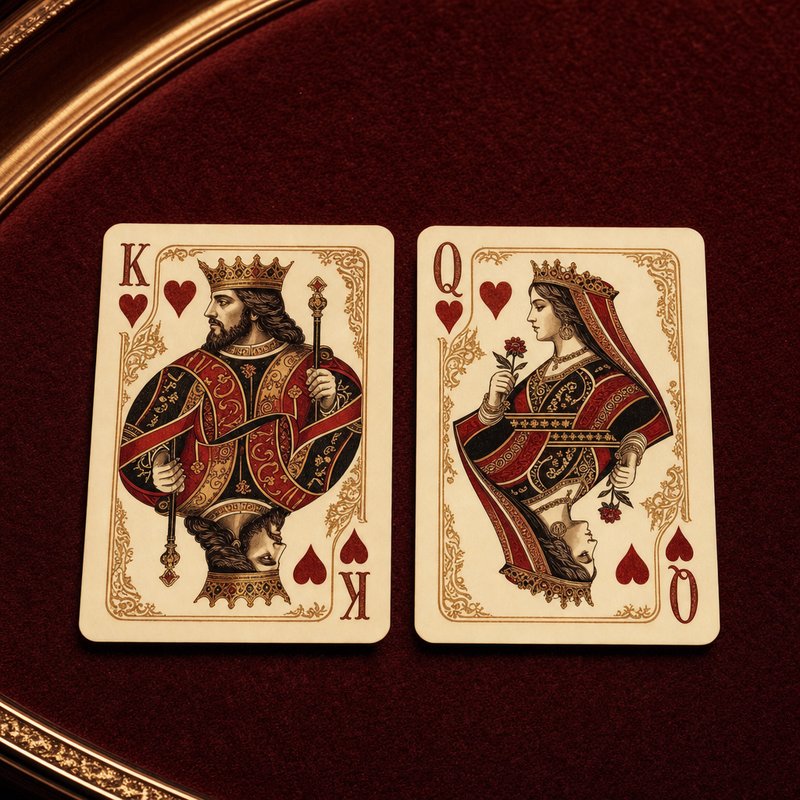
Royal Match payouts: easy match and the royal
| Outcome | Pays | Notes |
|---|---|---|
| Royal match (suited king and queen) | 25:1 | |
| Easy match (any two suited cards) | 2.5:1 | where nearly all wins land |
| Unsuited hand | Loss |
Before dealer-bust ladders and poker crossovers colonized the felt, there was a simpler proposition: are your two cards the same suit? Royal match blackjack has been asking it since the early 1990s, making it one of the oldest branded side bets still in circulation, a wager that predates most of the games it now shares a layout with. Two suited cards pay a modest 2.5:1. A suited king and queen, the royal match itself, pays 25:1 and gives the bet its name and its crown-heavy artwork.
Longevity bred variants, and the variants are where players get taken. The same royal branding now covers schedules priced anywhere from a defensible 3.7% to past 11%, and nothing on the sign warns you which one you’ve sat down at. Six versions, one crown, a threefold spread in what the bet actually costs: that’s the whole reason this page exists, and telling the editions apart takes less time than a shuffle.
You’ll have the tools by the end of it.
How royal match blackjack works
The bet goes down before the deal beside a live main wager and resolves on your first two cards alone; the dealer’s hand only matters in the bonus variants. Two cards of the same suit, any ranks: easy match. King and queen of the same suit: royal match. Anything unsuited loses, including pairs, straights-in-waiting and every other near-miss the felt can produce.
Settlement is immediate. The dealer grades the two cards the moment they land, pays or sweeps before any player acts, and the blackjack hand proceeds untouched, so a royal match collected on the way to a miserable sixteen is still a royal match collected in full. Splitting doesn’t revive the wager either: the bet reads your original two cards once, and whatever those cards become afterward is the main game’s business.
The math splits cleanly between the rungs, and it’s simple enough to verify yourself. In a six-deck shoe your first card can be anything; of the 311 cards remaining, 77 share its suit, so an easy match lands on just under a quarter of all hands. The royal is another matter. Each suit holds six kings and six queens across the shoe, giving 36 suited king-queen pairings per suit and 144 across all four, against 48,516 possible starting hands: about one occurrence in 337. Frequent enough that a regular player will hit a few. Rare enough that 25:1 keeps the house well ahead.
Notice how much work the easy match does in that arrangement. A bet that wins a quarter of the time feels alive in a way most side wagers don’t, and 2.5:1 on a near-1-in-4 event is precisely calibrated to feel generous while returning well under fair value. The royal rung supplies the story; the easy rung supplies the margin.
Wizard of Odds puts the plain six-deck version at a 6.67% house edge. That’s the baseline, and it’s not the version you should be looking for. Better editions of the same bet exist in the same buildings, sometimes in the same pit, and the rest of this page is about telling them apart.
The pay tables: one name, six price tags
Three decades of tinkering left a family tree worth reading before you sit down. The versions Wizard of Odds tracks:
| Version | Easy match | Royal match | Extras | House edge |
|---|---|---|---|---|
| Single deck (original) | 3:1 | 10:1 | none | 3.77% |
| Six deck, plain | 2.5:1 | 25:1 | none | 6.67% |
| Six deck + suited BJ | 2.5:1 | 25:1 | suited blackjack 5:1 | 3.70% |
| Dealer-bonus (6 deck) | 2.5:1 | 25:1 | both royals 1000:1 | 5.86% |
| Progressive | not paid | $60 fixed | Crown Treasure jackpot, $500 envy | varies with meter |
| Fixed-bonus (newest) | 2:1 | 50:1 | Crown Treasure $1,000 | 11.3–11.5% |
The spread is the story. Adding one 5:1 rung for a suited blackjack nearly halves the price of the six-deck game, from 6.67% to 3.70%; that schedule is the family’s best buy and the one worth hunting. At the other end, the newest edition doubles the royal to 50:1, staples on a $1,000 Crown Treasure bonus, and quietly charges over 11% for the fireworks. Bigger numbers on the sign, worse bet underneath.
The original single-deck version, at 3.77%, is mostly a museum piece now. Suited hands are scarcer with one deck, so it paid the easy match a fatter 3:1 and kept the royal at a modest 10:1. You’ll rarely find it dealt, but it explains why older strategy books quote royal match numbers that look nothing like today’s felt, and it’s a neat fossil record of how the bet repriced itself as casinos moved from pitch games to shoes.
Crown Treasure and the dealer-match variants
The bonus editions all orbit one fantasy: royalty on both sides of the table. The dealer-match version, the schedule ShuffleMaster shipped on its TMS 300 electronic tables per Wizard of Odds, pays 1000:1 when your royal match meets a dealer royal match on the same hand. The progressive edition goes further, wiring that double-royal event, branded Crown Treasure, to a meter jackpot and paying a $500 envy bonus to every other player who had the bet up when someone hits it.
Treat these the way this site treats every jackpot rung on the full side-bet board: as theater with a cover charge. If your own royal is a 1-in-337 event, requiring the dealer to hold one simultaneously multiplies the rarity into six-figure territory, and the base schedules funding those bonuses give back the difference on every ordinary hand. The 5.86% dealer-bonus version costs half again the price of the 3.70% table for the privilege of a payout you will statistically never see.
There’s a respectable design lesson buried here, though. Royal match walked this road first, with the small frequent rung, the rare branded jackpot and the envy bonus, and you can see its fingerprints on everything from Perfect Pairs tiers to the poker-hand ladders of the 21+3 side bet. The imitators refined the pricing. The original kept the crown.
Reading a royal match felt in ten seconds
Since the name guarantees nothing, check two things. Does the schedule list a suited-blackjack rung at 5:1? That’s the 3.70% table, the only version priced with the reasonable side bets. Does it advertise a 50:1 royal or a fixed $1,000 Crown Treasure? That’s the 11% edition wearing party clothes. The plain 25:1/2.5:1 felt sits between them, at 6.67%. Two glances, one at the extras line and one at the royal’s number, and you’ve priced the table more accurately than most of the people already seated at it.
Cost it out in chips and the differences stop being abstract. A $5 royal match bet every hand runs about 33 cents a round in expected loss on the plain schedule, past 55 cents on the fixed-bonus edition, and roughly 19 cents on the suited-blackjack table. Over a 60-hand hour that’s the difference between an $11 tab and a $33 one. Same artwork, same crown, same dealer, and one seat costs a third of what the seat two pits over charges for the identical experience.
Availability follows age. Royal match no longer enjoys the wall-to-wall spread of the modern standards, and plenty of newer rooms skip it entirely in favor of the two default toggles, but it survives in scattered pits, on electronic tables, and at online casinos that license the classic schedules. When you do find it, the version identification above is the whole game; the bet itself hasn’t changed its manners in thirty years.
No counting system rescues any of these. The bet lives on suit agreement, invisible to rank-based counts, and no practical technique tracks suits deeply enough to matter. What you read on the felt is what you pay.
So the verdict is conditional, which for once isn’t fence-sitting: at 3.70% royal match blackjack is a fine, quiet, historically interesting entertainment bet, cheaper than most of what surrounds it. At 6.67% it’s mediocre, and the newest edition is a donation with heraldry — how those percentages translate into dollars per hour is laid out in the blackjack odds primer. Thirty years on the felt earned this bet its crown; it didn’t earn it your chips at any posted price.