Game variant
Free Bet Blackjack: Rules, Strategy and the Real House Edge
The house pays for your doubles and splits, then claws it back every time the dealer lands on 22. Here is how the trade actually nets out, which strategy changes matter, and when this table beats the classic game.
Published Tuesday, June 16, 2026 · Updated Sunday, July 26, 2026 · 14 min read
The free bet blackjack rules that define the game
| Outcome | Pays | Notes |
|---|---|---|
| Free double offered on | Hard 9, 10, 11 | two-card totals only |
| Free split offered on | Any pair except 10s | includes free re-splits |
| Win a free double | 2× your original bet | the house covered the double |
| Lose a free double | 1× original bet lost | the free chip simply vanishes |
| Dealer makes 22 | Push | all live player hands push, blackjacks still win |
| Player blackjack | 3:2 | on the standard tables |
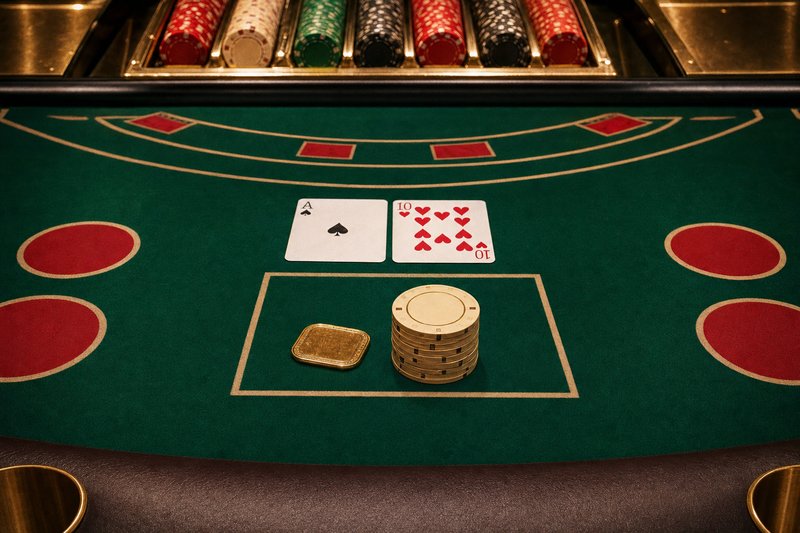
Watch a Free Bet Blackjack table for ten minutes and you’ll see the pitch work in real time: a player draws hard 11, the dealer slides a gold lammer next to their chips (a double, on the house) and the table hoots like something illegal just happened. Then the dealer draws out to 22, taps the felt, and every hand pushes. Nobody hoots at that part. Those two moments are the same transaction viewed from both ends, and understanding the exchange rate between them is everything this game is about.
Free bet blackjack is the most successful blackjack variant of the last two decades for a reason: it takes the two most exciting moves in the game and makes them free, then finances the gift with a rule subtle enough that most players never price it.
What is Free Bet Blackjack, and where did it come from
The game is the invention of Geoff Hall, the same designer behind Blackjack Switch, and is licensed to casinos through Scientific Games, today’s Light & Wonder. It arrived on Las Vegas floors in 2012 and spread the way good gimmicks do: fast, and with the math tucked under the marketing.
The frame is ordinary six- or eight-deck blackjack. Naturals pay 3:2 on the standard installs. What changes is who funds your aggression:
- Free double on any two-card hard 9, 10 or 11. The dealer marks it with a lammer; you risk nothing extra.
- Free split on any pair except ten-value cards, with free re-splits, a hand can sprawl into a small estate of the casino’s money.
Win a free-doubled hand and you’re paid as though you’d doubled with your own chips. Lose it and only your original bet leaves. It is, genuinely, free money on those hands, which should make you immediately suspicious about where the money comes from.
Push 22: the rule that pays for everything
Here is the funding mechanism: when the dealer busts with exactly 22, nothing happens. Every live player hand, stood, hit, doubled, split, free or paid, pushes. Dealer 23 or more still busts normally, and a player blackjack still gets paid before any of this applies.
That reads like a small tax. It is not. The dealer busts roughly 28% of the time, and 22 is the single most common bust total, because the most common bust is a ten landing on a stiff. Wizard of Odds prices the dealer 22 at 7.35% of all hands in the six-deck game, one round in thirteen or fourteen where the classic game would have paid the table and this one hands back a push. The phrase players mutter, push 22 blackjack, is accurate accounting: the 22 doesn’t beat you, it just quietly un-pays you.
That refund is the entire push 22 blackjack mechanic in one line. If you want to see how lopsided dealer bust totals really are, our dealer bust odds page charts the whole distribution; the 22 spike is unmissable. The variant’s cousin wagers, the Buster Blackjack side bet family, monetize the same busts from the opposite direction.
Free Bet Blackjack strategy: the chart deltas that matter
Free bet blackjack strategy starts with two commandments that cover the large majority of decisions:
- Take every free double. All of them. Hard 9 against a dealer ten included. The chip is free; declining it is burning equity.
- Take every free split. Same logic, including re-splits. Yes, even the pairs basic strategy hates, because you are not paying for the privilege.
The finer print is where Push 22 reshapes the classic chart. Standing on a stiff total is a bet on the dealer busting, and this game refunds a slice of those busts to the house as pushes. So the value of standing drops, and against the dealer’s weakest upcards you hit hands you were taught never to hit: several 12-to-14 totals against a dealer 2, 3 or 4 flip from stand to hit. The published optimal charts (Wizard of Odds carries the full grid) mark maybe a dozen such cells, learn those, plus the two commandments, and your free bet blackjack strategy is playing within a whisker of the 1.04%.
What does not change: never touch a ten-pair. There is no free split on tens anyway, and splitting them with cash remains the classic blunder. And the free bet blackjack rules don’t offer free doubles on soft hands, so your soft-total chart stays the classic one.
One honest aside from the grind: the game feels looser than it plays, because free chips hit the felt constantly. Keep your base bet where you’d set it at a classic table. The variance is real even when the doubles aren’t yours.
House edge and odds versus regular blackjack
Priced with optimal play, the common six-deck, hit-soft-17 install runs about 1.04%, Wizard of Odds’ figure, and the one Nevada’s filed rule sheets are consistent with. For context on the free bet blackjack odds ledger:
| Table | House edge (optimal play) |
|---|---|
| Classic 3:2, good rules | ≈ 0.5% |
| Free Bet Blackjack | ≈ 1.04% |
| Classic paying 6:5 | ≈ 1.9–2.0% |
| Typical side bets | 3–25%, see the board |
That middle row is the game’s whole argument, and it cuts both ways. Sitting next to a healthy 3:2 shoe, Free Bet costs you an extra half percent for the fireworks. Sitting in a pit where every classic table pays 6:5, which describes a lot of American floors now, Free Bet Blackjack is the cheapest real blackjack in the room, and it’s not close. The house edge guide puts these numbers alongside every other table in the building if you want the full ranking.
The side bets on the felt
Being a modern variant, the layout arrives pre-loaded with extras:
- Pot of Gold, pays by how many free bets you collect in a single round, scaling from small odds for one lammer to jackpot money for four or more. It’s the natural companion bet, and like every companion bet it runs an edge several times the main game’s.
- Push 22 side wagers and progressives, some installs, including the Free Bet Blackjack with Push 22 Progressive version filed with Nevada’s Gaming Control Board, let you bet on the dealer 22 directly. Bitter-sweet by design: the round your hand pushes is the round your side bet cashes.
Both belong on the same shelf as everything else on our side-bet board: entertainment priced accordingly, sized at a tenth of your main bet or left alone.
Finding a table, and the one felt to avoid
Free Bet runs across the Strip, Atlantic City, and the regional circuit; Evolution’s Infinite Free Bet Blackjack streams the identical rule set to regulated online lobbies with unlimited seats. The install base is broad enough that you rarely have to hunt.
Just read the felt before you sit. The standard game pays blackjack at 3:2; a few properties quietly run the variant at 6:5, which erases the entire value proposition and then some. Free doubles funded by shortchanged naturals is a trade nobody should take, the whole point of this table is that, played right, the gimmick genuinely is the good deal.